Clay Shirky es profesor del Interactive Telecommunications Program de la Universidad de Nueva York, donde investiga los efectos interrelacionados en las redes sociales y tecnológicas. Ha asesorado a una gran variedad de empresas e instituciones, tales como Nokia, BBC, Newscorp, Microsoft, BP, Lego, la Biblioteca del Congreso y el ejército de Estados Unidos. Asimismo, sus artículos se han publicado en The New York Times, The Wall Street Journal, The Times, Harvard Business Review, Business 2.0 y en Wired. Es autor del betseller mundial Here Comes Everybody (Penguin, 2008).
Recibe novedades de CLAY SHIRKY directamente en tu email
A handful of kite hobbyists scattered around the world find each other on-line and collaborate on the most radical improvement in kite design in decades. A few people find that a world-class on-line encyclopedia created entirely by volunteers and open for editing by anyone, a wiki, is not an impractical idea. Jihadi groups trade instruction entirely on-line. Our ages new technologies of social networking are evolving, and evolving us. New groups are doing new things in new ways, and were doing the old things better and more easily. Business models are being transformed at dizzying speeds, and the larger social impact is in a way so profound that its under-appreciated. In Here Comes Everybody, one of the cultures wisest observers give us his lucid and penetrating analysis on what this means for what we do and who we are.
For decades, technology encouraged us to squander our time and as passive consumers. Today, tech has finally caught up with human potential. in Cognitive Surplus, Clay Shirky examines the changes we will all enjoy as our untapped resources of talent and good will are put to use at last.Since the postwar boom, we''ve had a surfeit of intellect, energy, and time - a ''cognitive surplus.'' Shirky argues persuasively that this cognitive surplus - rather than being some strange new departure from normal behavior - actually returns our society to forms of collaboration that were natural to us up to and through the early 20th Century. He also charts the vast effects that our cognitive surplus - aided by new technologies - will have on 21st Century society, and how we can best exploit those effects, and how the choices we make are not only economically motivated but driven by the desire for autonomy, competence, and community.
Welcome to the new future of involvement. Forming groups is easier than it's ever been: unpaid volunteers can build an encyclopaedia together in their spare time, mistreated customers can join forces to get their revenge on airlines and high street banks, and one man with a laptop can raise an army to help recover a stolen phone. The results of this new world of easy collaboration can be both good (young people defying an oppressive government with a guerrilla ice-cream eating protest) and bad (girls sharing advice for staying dangerously skinny) but it's here and, as Clay Shirky shows, it's affecting! well, everybody. For the first time, we have the tools to make group action truly a reality. And they're going to change our whole world.
Clay Shirky, um dos mais influentes pensadores da web, abre seu livro contando uma história simples: numa tarde de 2006 uma mulher perdeu um celular no banco de trás de um táxi. O telefone foi encontrado, a identidade de quem estava de posse do aparelho foi revelada, mas isso no garantiu a sua devoluço. So depois que uma pagina na internet contando o caso ganhou a atenço da midia e o novo "dono" do aparelho foi pressionado por milhares de empenhados adeptos, o caso foi solucionado. A historia exemplifica bem a revoluço que as tecnologias de rede social vem desempenhando. Pela primeira vez na historia, os individuos tem nas mos os meios para se organizar sem a intermediaço de empresas, partidos e outras instituiçes, compartilhando informaçes, produzindo de maneira colaborativa e ate planejando açes coletivas de grande porte. Mas "La vem todo mundo" no chega apenas para celebrar os beneficios dessa transformaço, Shirky apresenta os dilemas que emergem quando os grupos deixam de ser controlados por organizaçes. Se as novas ferramentas virtuais tornaram possivel que, na Bielo-Russia, por exemplo, eclodisse um protesto politico que o governo foi impotente para deter, tambem viabilizam uma comunicaço mais agil entre redes terroristas. Estamos diante de um panorama que transformou o comportamento dos homens, e o autor, alem de analisar os pontos positivos e negativos desse cenario, mostra como e possivel participar ativamente de um dos momentos mais ferteis da historia humana.
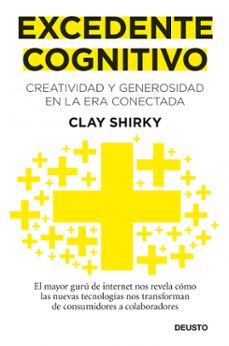
El impacto potencial del excedente cognitivo, esto es, el superávit de conocimiento de que disfruta nuestra sociedad, es enorme. Según Shirky, nuestra sociedad y nuestras vidas cotidianas mejorarán notablemente cuando aprendamos a aprovechar nuestro potencial altruista y nuestro tiempo libre. De hecho, el cambio ya esta aqui: para redactar la Wikipedia se empleo solo el 1% de las horas que los telespectadores estadounidenses pasan al año viendo television. Dicho en otras palabras, durante el tiempo en que los estadounidenses pasan ante el televisor durante un año podrian redactarse miles de wikipedias.Este cambio de paradigma es posible porque nos encanta colaborar, escribir en blogs y compartir en las redes sociales, y con ello sentirnos participes de algo grande. Ello permite poner nuestra inteligencia y nuestro tiempo libre a trabajar conjuntamente para crear cosas que de forma individual, o desde una empresa o institucion, seria imposible crear.